The Value of a Schoolwide Approach to Sound Spelling Cards

Updated: Apr 20
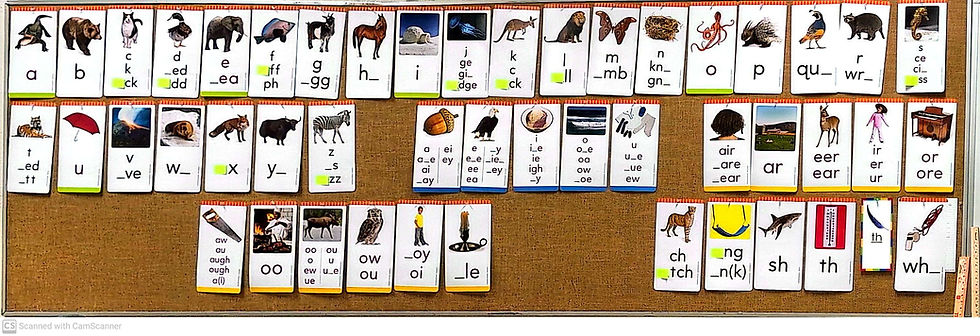
As literacy coaches, we often advise teachers and principals on the resources that they use for early literacy instruction. One of the most important types of materials we recommend is what is known as Sound Spelling Cards. The image below shows an example that represents the sounds of /ow/, /ch/, and /ng/. A typical set of Sound Spelling Cards would include about 45 cards, or approximately one card for each phoneme in English.

Sound Spelling Cards are grounded in structured literacy and the idea that reading and spelling improve when students are taught the relationships between phonemes (sounds) and graphemes (spellings) explicitly and systematically. They mimic the notion promoted by Dr. Louisa Moats that English should be taught from speech to print, not from letters to sounds.
A Sound Spelling Card gives a student a compact way to practice the mapping of speech to print over and over. They see a visual, connect it to a keyword, say the sound, see the spelling options for the sound and are then able to retrieve spelling patterns quickly in reading and spelling.
Research Supports the Idea of a Sound Spelling Card Wall
A lot of the research for Sound Spelling Card walls comes from several overlapping findings:
Explicit phonics instruction works. Teaching phoneme-grapheme correspondences directly is one of the most research-backed parts of early reading instruction.
Orthographic mapping matters. Students become fluent readers when they bond the pronunciation, spelling, and meaning of words in memory. Sound Spelling Cards help rehearse the sound-spelling side of that process using memorable pictures and keyword as a mnemonic device.
Systematic cumulative review helps retention. Sound Spelling Cards are often used in quick drills, which fits what we know about retrieval practice and repeated exposure.
Multisensory practice can support learning. This is especially true when it is tied to explicit instruction rather than used as a substitute for it. Sound Spelling Cards are multisensory tools that combine auditory and visual supports for students.
As a result of all of these benefits, we highly recommend that teachers use Sound Spelling Cards as the foundation for learning phonics.
Does the Design of Your Sound Spelling Card Wall Matter?
However, teachers and principals often ask us if it matters which cards they use.
For example, different classrooms might have different sets of cards that have different pictures, or that have different sets of graphemes. General education classrooms may have cards, and special education classrooms may have none, or they may be organized in different ways.
Now, as for having two or more sets of cards, that's really tricky. I work with a school that uses the cards that come with the Heggerty program and the pictures are different from their core reading program (Wonders). The Heggerty cards are used during the phonemic awareness instructional time and students are taught to bridge the two programs. Teachers say things like, "What is the picture on our Wonders cards?" and the students answer. You might imagine that this would work for some students, but it's a lot for other students to remember.
If students have three or more sets to reference, that can make it even more confusing, especially for those who struggle with retrieval or who process information at slower rates.
Teachers are often tempted to use various sets of cards for different reasons, such as a set for alphabet recognition and another set for phonemic awareness activities. This is usually because they are using multiple programs with different resources or because their core reading program hasn't done the work of aligning all their resources.
I have seen where teachers have an alphabet strip on their wall with pictures as well as the Sound Spelling Cards that come with Wonders. In this situation, the alphabet strip may have a cat for the C card and a kite for the K card because the pictures are organized around the letters. On the other hand, the core program might have a clock for the /k/ sound. In this situation, where would students look to find help spelling and reading the sound of /k/ and the options of c, k, or _ck? Do they look to cat, kite, or clock?
I find it curious as to why some teachers seem reluctant to focus on just one set. One set can really ground early readers and solidify their understanding of phonics. Often it turns out teachers don't quite understand the purpose of the Sound Spelling Cards, or they are unduly committed to their prior experience with specific resources they enjoyed.
I frequently coach teachers and principals in these kinds of situations to think about how they are applying the Science of Reading as a coherent, well-thought-out system. For example, what would happen if we introduce the sound-to-spelling connection to our students using one set of cards in every single classroom K-5? What would happen if students had the same visual reference from Day 1 of Kinder all the way through their last day in elementary school? What would happen if general education and special education classrooms took the mental load off students so they didn't have to transition from one visual model to another?
I'm not only confident that students will build improved automaticity with orthographic mapping by only having one set to map in memory – I have seen it work time and again in every school that takes this approach.
A Matter of Cognitive Load
Some educators think: Rosie, I can see what you're saying, but does that mean I have to get rid of my other cards?
It's a good question, but here's what is at stake when schools implement different visual representations for the same sound-to-spelling by having an alphabet wall, handwriting cards, Wonders Sound Spelling Cards, Heggerty cards, and more – the issue becomes a cognitive load and memory retrieval concern.
For struggling readers, having multiple, conflicting visual anchors slows down orthographic mapping. They have to exert their mental energy on figuring out the multiple visual stimuli and make decisions about which card systems to use.
One goal of phonics instruction is automaticity of recall with all the phoneme-grapheme correspondences, so consistency is key. To build automaticity, research supports minimizing extraneous visual stimuli that compete for limited working memory resources during the time students are learning to map phonemes to graphemes.
In other words, by having one Sound Spelling Card system, you better support your most vulnerable learners by helping them focus on the what is most important.
Implement One Well-Designed Set
For all of these reasons, we highly recommend that all early literacy educators use one well-designed set of Sound Spelling Cards and that the cards are consistent both within classrooms and across entire school environments.
If you would like help thinking through Sound Spelling Cards in your class or school, please reach out! We'd be happy to talk with you about this amazing approach to phonics instruction.